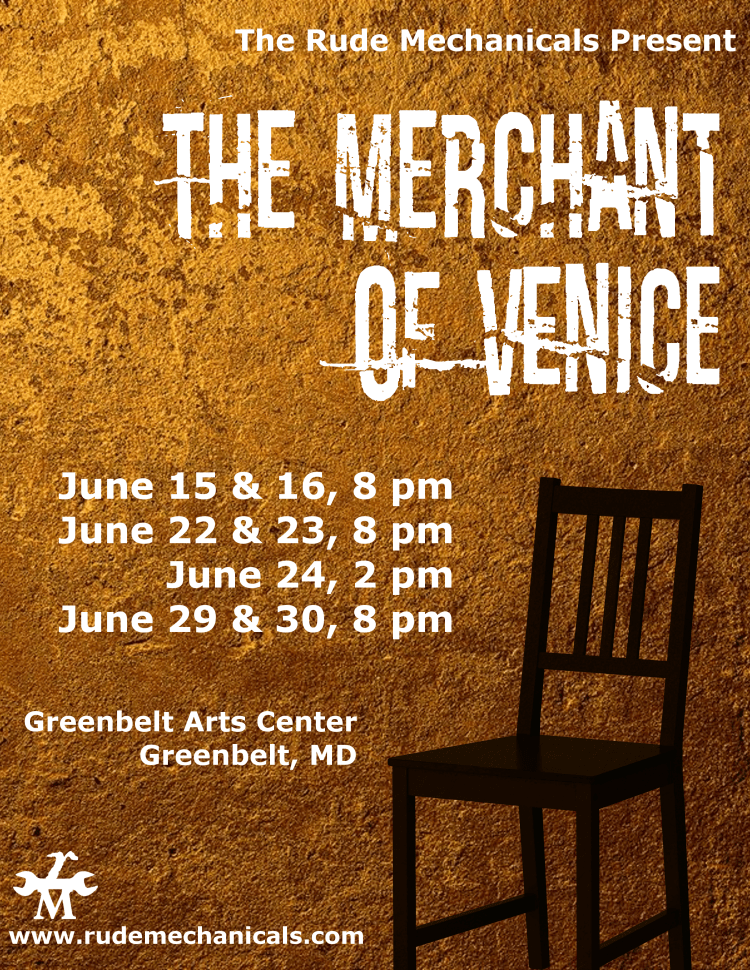
by William Shakespeare
directed by Claudia Bach
All that glisters is not gold. So warns Shakespeare that all may not be as we think in one of his most controversial yet increasingly relevant plays. In a mythically splendorous city full of wealth and celebration, injustice and cruelty lurk beneath the surface. One Jewish man, tired of his repeated abuses and losses, is presented with an opportunity to make Venice confront its own hate and hypocrisy. What follows is a dark series of events that challenges our understanding of right and wrong and forces us to examine what we might see if we could look past the glister and the gold.
Performances
Performances June 15-30, 2018 at the Greenbelt Arts Center.
Director’s notes
The Merchant of Venice is, to put it mildly, a challenging text. To Shakespeare’s audience, certainly, you would have had a straightforward tale of a noble merchant plagued by the villainous Jew, saved only by the goodness and wit of the ingenue. And yet this play issues one warning, in one form or another, over and over: “All that glisters is not gold.” This is a warning given to the suitors to Portia, and one that they do not heed. They get distracted by external opulence and the preconceived notions they enter with, and they miss the mark. What if we treated the text itself this way? What if we moved aside the gold and silver caskets, the carnivals of Venice, the wealth of Belmont, and any and all preconceptions about what this play is about and what these characters are like. Well, what does that leave us with?
I think once you do that, you’re left to grapple with some very difficult parallel truths about these characters and their situation. Because there’s a very real discord here. Between characters we’re inclined to think of as protagonists, as heroes, and the very tangible acts of cruelty they engage in. Between an antagonist, a presented villain, and his systematically laid out and legitimate grievances. Between the drinking and carnivals of a happy-go-lucky Venice, and the undercurrent of oppression and bigotry that infects everything. And the play that you are left with may force us to examine how the heroic and the cruel exist side by side, in a person, in a relationship, and in a society – then and now.
Reviews
“Bach […] succeed[s] triumphantly in her creative doings.”
–Amanda Gunter, TheatreBloom
“All of the elements in this production of The Merchant of Venice work in harmony to amplify the themes of complex human nature.”
–Betsy Lizotte, DC Metro Theater Arts
Production Photos
Photos by Rachel Duda Photography







 Claudia H. Bach